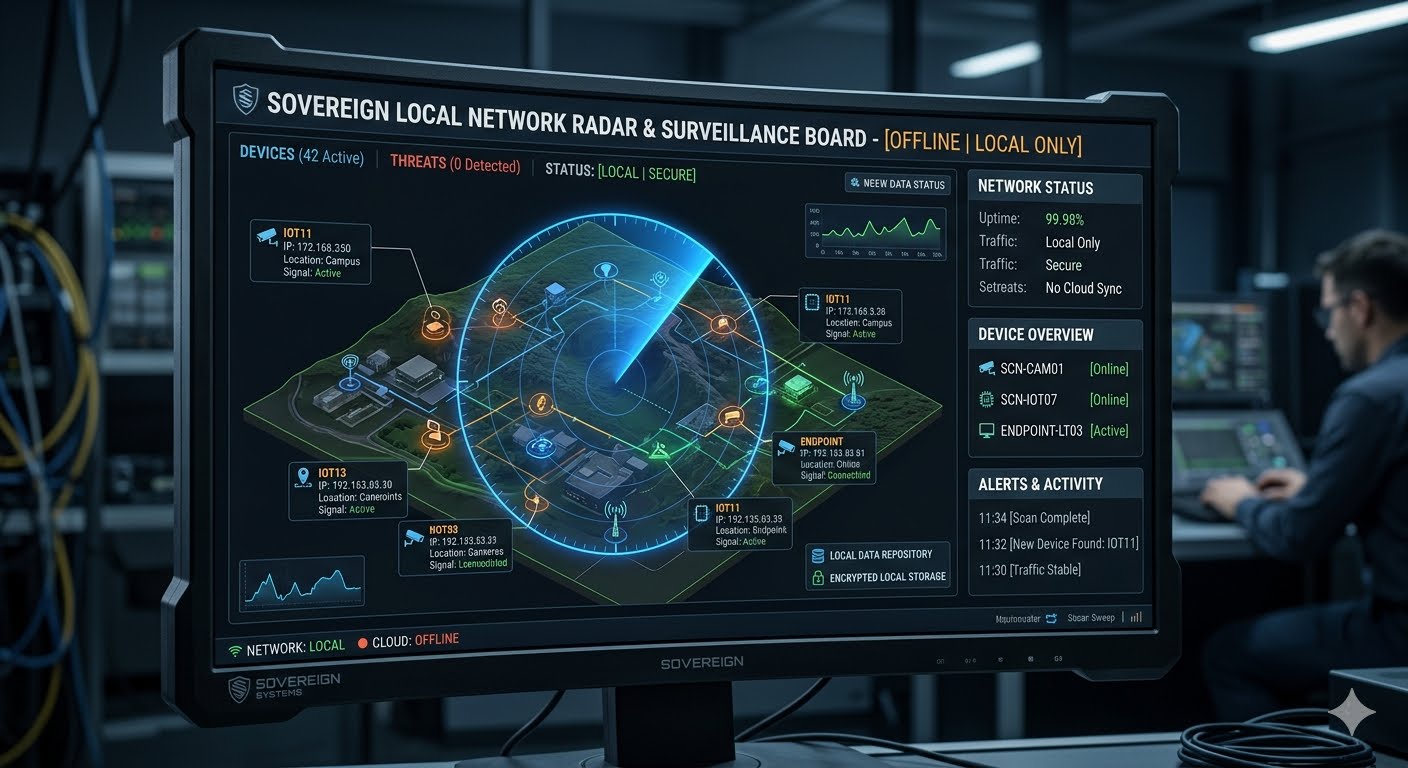
The Invisible Threat inside Your Home
We live in an era of unprecedented wireless expansion. At any given moment, dozens of devices inside and around your home—smartphones, laptops, streaming sticks, smart TVs, and internet-of-things (IoT) appliances—are constantly broadcasting digital signals across your rooms. Most consumer network monitors rely on corporate cloud servers to track these devices. This means a corporate entity is continually auditing your home habits, logging when your family members connect, and mapping your private hardware footprint in the cloud. If the internet goes down, you are left completely blind to who or what is tapping into your local frequencies.
The Autonomous Alternative
Project Ibris v1.0 (Subnet Radar Edition) is a completely open-source, database-free local area network surveillance board designed to bring absolute hardware visibility and data sovereignty back to individuals, homesteads, and privacy purists. Written in clean, optimized Python and leveraging Linux’s native, raw network-mapping engines, this software completely cuts out cloud reporting and big tech monitoring.
It transforms any standard computer—including old, repurposed desktop machines with no webcam or external sensors—into an independent, automated digital sonar station.
How the Signal Radar Engine Operates
The application bypasses software abstractions to query your system’s network adapters directly. Once activated, it runs an unkillable background loop that acts as a local signal radar:
-
- Silent Sonar Scanning: Every 15 seconds, the engine shoots a fast, silent digital ping pass across all 254 channels of your home network router’s specific grid lane.
- Hardware Intercept Mapping: It catches the raw hardware handshakes bouncing back through the airwaves, immediately parsing out the exact IP and MAC address strings of every active node.
- Tactical HUD Ledger: It formats the results into a crisp, high-contrast terminal matrix screen, instantly logging your total active device count. It isolates infrastructure endpoints with an amber
[GATEWAY ROUTER]designation tag, while tracking personal laptops, tablets, and smartphones with clean, neon-green[ACTIVE DEVICE]status indicators.
Why True Privacy Advocates Need It
Project Ibris is built on zero-trust architecture. It requires zero cloud profiles, zero database installations, and zero internet tracking lines. The entire footprint is microscopic, running completely inside your machine’s local RAM cache. If a neighbor tries to hijack your Wi-Fi signal, or if a rogue smart device triggers an unauthorized background connection, the radar screen records the node joining the matrix in real time. It gives you an unshakeable, independent audit of your property’s electronic boundaries—ensuring that what happens inside your home stays inside your home.
📥 Standalone Distribution Download Block
📦 Release Asset Package
💾
PROJECT_IBRIS_RADAR_v1.0.zip-
- Core Logic:
net_radar.py(Local Area Network Signal Engine) - Automation Launchers:
install.sh(Automated System Installer) |launch_radar.sh(One-Click Trigger) - License: Copyleft GNU GPLv3 Open Source
- Core Logic:
🛠️ 3-Step Instant Field Deployment Checklist
- Extract the Files: Download and unzip
PROJECT_IBRIS_RADAR_v1.0.zipdirectly onto your desktop workspace. - Run the System Installer: Open a terminal window inside the extracted folder and execute the automated setup script to pull down your local hardware scanning drivers automatically:
bash
chmod +x install.sh && ./install.shUse code with caution. - Monitor Your Grid: Double-click
launch_radar.sh(or executepython3 net_radar.pynatively in your terminal console). Your offline tactical surveillance board is officially live and broadcasting!